

Table of Contents
- Start With a Realistic Hygge Budget and One Room
- Build a Cozy Home on a Budget With Textiles First
- Hygge Lighting Ideas That Cost Little and Save Energy
- Small Apartment Cozy Decor: Renter-Friendly Solutions
- DIY Hygge Home Decor Using What You Already Own
- Natural Materials, Neutrals, and Thrifted Finds
- Mistakes That Quietly Break the Hygge Feeling
- Frequently Asked Questions
Last Updated: October 18, 2026
Start With a Realistic Hygge Budget and One Room
Creating a hygge home on budget starts with one room and one honest number: pick where you actually unwind, set a spending cap, and finish it before you touch another.
Hygge is the Danish idea of a warm atmosphere built on soft light, natural textures, and unhurried comfort, a feeling, not a look. One room done well beats five half-done.
Here is the order we follow.
- Pick one room. The living room or bedroom usually gives the biggest payoff.
- Set a hard cap. Decide the number before you shop.
- List what you already own. Half your cozy items are probably in a cupboard.
That last point is where budgets go wrong: people buy a big furniture piece first, then have nothing left for the layers that make a room feel soft.
The Three Cost Tiers: Frugal, Moderate, and Splurge
Three tiers keep a budget honest. Use this table as a planning guide, then adjust the numbers to your own cap.
| Tier | What It Covers | Where to Spend | Where to Save |
|---|---|---|---|
| Frugal | What you already own, thrifted finds, DIY | Lighting you can reuse | New furniture, art |
| Moderate | One or two quality textiles, a real rug | Blankets, pillow covers, rug | Seasonal decor |
| Splurge | One solid wood or handcrafted anchor piece | A candle holder set or storage box | Throw pillows, candles |
Don't treat all three tiers as goals. Start at frugal and move up only when a piece will stay with you for years.

Build a Cozy Home on a Budget With Textiles First
Textiles are the fastest, cheapest way to make a room feel cozy. A blanket, two pillow covers, and a rug do more for warmth than a new sofa. Fabric absorbs sound, softens hard edges, and adds the layered texture that defines a hygge room.
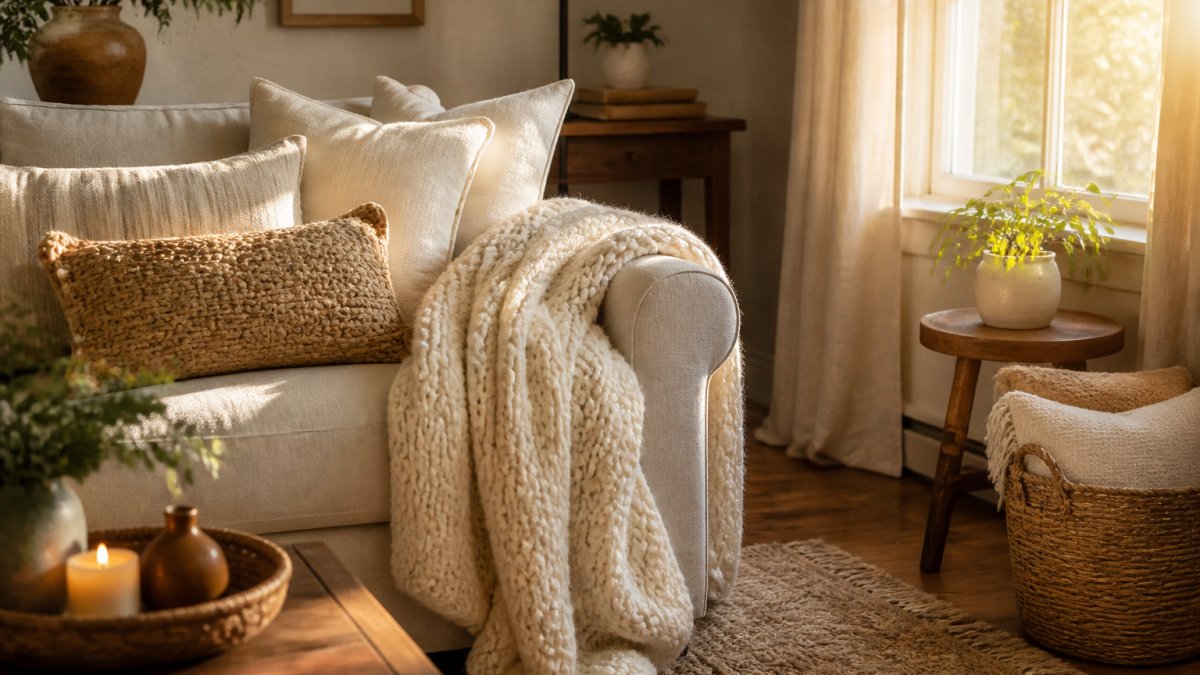
Start with three pieces and stop there for a month. Living with them shows what the room still needs and stops you buying twice.
Blankets, Throws, and Chunky Knits
A throw blanket is the single most useful cozy purchase you can make. Drape it over a chair arm or fold it at the foot of the bed. Chunky knits add bulk and texture, which reads as warmth even in a plain room.
- Look for natural fibers: wool, cotton, or a cotton blend.
- Choose a neutral you will still like in five years.
- Buy one good throw rather than three thin ones.
Placement matters more than price: a blanket folded on a bare chair looks intentional; the same blanket stuffed in a basket looks like laundry.
Pillows, Cushions, and a Floor Rug
Pillows and a rug finish the job.
Our Tuban Lumbar Pillow Cover is a good example of the approach. The braided jute over cotton adds texture in a neutral tone, so it layers with what you already own instead of fighting it.
A floor rug defines a space and warms a cold floor; in a small apartment, it can make one zone feel like a separate room.
Hygge Lighting Ideas That Cost Little and Save Energy
Hygge lighting ideas come down to one rule: no bright light at eye level after dark. Swap overhead bulbs for low, warm sources and the room changes in an evening.
Here is how we would approach it:
- Turn off the ceiling light. Use it for cleaning, not for evenings.
- Add two low light sources per room. A table lamp and a candle grouping is enough.
- Choose warm bulbs. Look for a warm color temperature on the box rather than a bright white.
- Use a timer or smart plug. Lights come on before you get home, and you stop paying for lights left on all day.
- Group candles at different heights. Height creates the flicker and shadow that make a room feel alive.
Candles and tea lights are the cheapest hygge lighting there is. A wooden holder lifts them off the surface and adds natural material; our Ribbed Wooden Pillar Candle Holder comes in three heights, sold separately, so you can build a grouping over time.
Safety matters: keep candles away from curtains and anything that drapes, and never leave a room with one burning.
Per Energy Star guidance on lighting, LED bulbs use far less energy than older bulbs and last for years, which makes the switch to warm, low lighting cheaper over time than it looks.
Small Apartment Cozy Decor: Renter-Friendly Solutions
Small apartment cozy decor works by adding warmth in layers, not objects.
Renters face two limits: no permanent changes, and often no extra storage. Both are solvable.
- Use vertical space. Shelves and wall hooks add storage without taking floor area.
- Choose pieces that store things. A lidded basket holds blankets and looks intentional doing it.
- Go for removable fixtures. Plug-in sconces and adhesive hooks come down without damage.
Our Woven Lidded Storage Box is built for this: the seagrass texture adds warmth, the lid hides the mess, and the four sizes stack, so a small closet or shelf stays tidy without new furniture.

Decluttering is part of the budget plan: every item you remove is space you do not have to buy storage for.
DIY Hygge Home Decor Using What You Already Own
DIY hygge home decor starts with a walk through your own home, not a shopping trip. Most people already own the raw materials for a cozier room, they just have not grouped them. Do the free moves first, then decide whether a purchase is needed.
Here is the order we would follow, room by room, before spending anything.
Living Room: The Free First Pass
The living room gives the biggest payoff because it is where most people sit in the evening.
- Move the lamp before you buy one. A floor lamp pulled 18 inches from the wall and angled toward a chair changes a whole corner; against a wall it reads as task lighting.
- Refold and regroup your blankets. A neat stack on an open shelf or a single throw draped over a chair arm reads as decor. The same blankets in a pile read as laundry.
- Rearrange one shelf in threes. Group a book stack, a candle, and a small plant; odd numbers and varied heights do the work new objects would.
Bedroom: The Free Second Pass
The bedroom is the second-highest payoff room because it is where the day starts and ends. The free moves here are about softness and light.
- Swap art between rooms. A frame you have stopped seeing in the hallway is new above a bedside table.
- Move a small lamp to the bedside. A low, warm light within reach of the bed does more for the room than an overhead fixture.
- Repurpose a mug or jar as a tea light holder. A wide mug or a clean jam jar works. Set it on a saucer to catch wax.
The No-Buy Rule and When to Break It
Our rule: if it is already in the house, it is free. Move it first, buy second, buying a decorative object to solve a problem rearranging would have fixed is a common mistake.
Break the no-buy rule only when a free move reveals a real gap. If you have moved the lamp, regrouped the textiles, and the room still feels flat, the missing piece is usually a warm bulb, a textured pillow cover, or a large enough rug, purchases that earn their place by solving a problem the free pass exposed.
Natural Materials, Neutrals, and Thrifted Finds
Natural materials and neutral colors keep a cozy room from looking dated. Wood, linen, jute, and seagrass age well; trend colors do not. A neutral base lets you change accents without replacing the room, the budget question is which materials to buy first.
A Prioritized Shopping Order for Natural Materials
Most people buy natural materials in the wrong order, starting with decor and ending with the pieces that actually change how a room feels. Here is the order we follow, with rough cost tiers.
- Lighting first (frugal tier). A warm bulb and a secondhand lamp base are the cheapest natural-material upgrade you can make. Look for wood, ceramic, or linen shades at thrift stores. A warm bulb is a small purchase that changes every surface in the room.
- Textiles second (moderate tier). One good throw in wool or cotton, two pillow covers in a neutral weave, and a rug large enough to sit under the front legs of your furniture. These are the pieces that absorb sound and soften hard edges.
- Wood and woven storage third (moderate tier). A lidded basket or a woven box hides clutter and adds texture at the same time. Buy one that fits the space you actually have, not the one you wish you had.
- One anchor piece last (splurge tier). A solid wood side table, a handcrafted candle holder set, or a single piece of framed art. This is the piece you will still like in five years, so it is worth waiting for.
Don't treat all four tiers as goals. Start at the frugal tier, move up only when a piece will stay with you for years, and stop when the room feels finished.
Thrifting Natural Materials Without Wasting Money
Thrifted finds fit this approach perfectly. Older wooden pieces are often solid rather than veneered and carry the wear that makes a room feel lived in. Check joints, look for real wood grain, and skip anything with a strong smell.
- Bring a photo of your room. It stops you buying a piece that is beautiful on its own but wrong for the space.
- Check the underside. Real wood grain on the bottom and back is a better sign than a label.
- Skip particleboard with a wood-look veneer. It does not age the way solid wood does.
Our Whitewash Candle Holder Set shows how a natural finish works in practice: the light wood with a wash of white paint sits easily beside thrifted wood, linen, and neutral textiles, fitting a collection built over years rather than replacing it.

Renter-Friendly Natural Material Swaps
Renters face two limits: no permanent changes, and often no extra storage. Both are solvable with natural materials that come down without damage.
- Use removable hooks for woven wall pieces. A small woven basket or a dried branch on a removable hook adds texture without touching the wall.
- Choose plug-in lighting with natural shades. A linen or paper shade on a plug-in lamp gives the same warm light as a hardwired fixture.
- Use lidded baskets for storage. A woven lidded box holds blankets and looks intentional doing it, which matters in a small space.
Flowers help too, and they do not need to be a bouquet: a single stem in a small vase or a bowl of fruit is enough.
- Stick to two or three neutral tones per room.
- Mix at least three textures: wood, woven, and soft fabric.
- Let one piece carry the character.
Climate plays a part as well. In a cold home, heavier knits and a rug do the most work. In a warm one, linen and lighter weaves keep the same feeling without the heat.
Mistakes That Quietly Break the Hygge Feeling
The fastest way to lose the hygge feeling is to overfill a room. Hygge needs breathing space.
The mistakes we see most often:
- Too much overhead light. Bright white light flattens a room and kills shadows.
- Too many small objects. Clutter cancels out every cozy thing around it.
- Buying trend colors. They date fast and force a redo.
- Skipping texture. A room of smooth surfaces feels cold, however neutral it is.
- Doing every room at once. Nothing gets finished and the budget runs out.
- Ignoring function. A cozy chair you cannot sit in comfortably is not cozy.
The fix for most of these is subtraction. Remove three items from a surface and look again.
Accessibility matters too: cozy should mean comfortable for everyone who uses the room.
Climate plays a part as well. In a cold home, heavier knits and a rug do the most work.
Frequently Asked Questions
How much does it cost to create a hygge home on a budget?
You can make real progress for under $50 if you start with one room and shop secondhand. A thrifted wool blanket, a couple of tea lights, and a borrowed floor lamp moved to a low corner change the feel of a space immediately. Textiles and lighting do most of the work, and both can be found at charity shops, estate sales, or discount stores. Set a small monthly hygge fund and add one or two pieces at a time rather than buying a full room at once.
What are hygge lighting ideas that don't raise my energy bill?
Swap overhead bulbs for warm LED candles, fairy lights, or a low-wattage table lamp with a 2200K to 2700K bulb. Warm LEDs use a fraction of the power of halogen and last years longer. Place light at three heights, such as a floor lamp, a table candle, and a small light on a shelf, so shadows soften instead of flooding the room. Battery tea lights in wooden holders give flicker without any draw on the grid.
How can I make a small apartment feel more hygge without new furniture?
Renters can layer texture without drilling or buying: drape a throw over the back of a chair, add a lumbar pillow cover to an existing cushion, and roll out a rug to define a sitting zone. Move one lamp away from the ceiling and closer to eye level. A woven lidded storage box hides clutter on an open shelf, which does as much for calm as any new sofa. Group candles and books on a tray to make a small, intentional vignette.
Can I decorate for hygge using things I already have at home?
Yes, and DIY hygge decor often looks better than bought pieces. Fill a jar with dried flowers or branches from a walk, stack books you already own beside a chair, and move a wooden cutting board to the wall as a display. Repurpose a basket as a blanket holder or a tray as a candle base. The only rule is to keep the arrangement simple and let natural materials, wood, linen, and seagrass do the visual work.
A cozy home rarely comes from one big purchase. It comes from a cap you stick to, one room you finish, and small layers added over time. If you want a head start on the lighting and texture side, Charmed Cottage Living curates solid wood candle holders, woven storage, and textured textiles built to sit together. Start with the room you use most, add two warm light sources and one soft textile, and see how different it feels before you spend another dollar.