

Last Updated: October 30, 2026
Quick Summary
The best farmhouse lighting for a cozy living room layers several warm, low sources instead of relying on one bright ceiling light. Use a chandelier or ceiling fixture for ambient light, add lamps at seating height for task light, and finish with accent lanterns, all with warm-white bulbs around 2700K.
- A single bright ceiling light makes a room feel like an office, so add two low lamps at seating height.
- Hang a chandelier's lowest point about 7 feet above the floor over an open seating area.
- Choose warm-white bulbs around 2700K for a soft amber glow, and avoid cooler bulbs above 4000K.
- Aim for roughly 10 to 20 lumens per square foot of ambient light, spread across several fixtures.
- Use dimmable bulbs on every fixture you can so the room works in the evening.
Table of Contents
- Why Lighting Decides How Cozy Your Living Room Feels
- How to Layer Lighting in a Living Room
- Choosing Farmhouse Chandeliers for Living Room Ceilings
- Warm Lighting for a Living Room: Bulbs, Brightness and Dimming
- Budget-Friendly Farmhouse Light Fixtures That Still Look Right
- Finishes, Materials and Mixing Farmhouse Styles
- Setting Up Your Cozy Living Room Lighting This Weekend
- Frequently Asked Questions
Why Lighting Decides How Cozy Your Living Room Feels
Lighting is the fastest way to make a living room feel cozy, and at Charmed Cottage Living we treat it as the starting point for any farmhouse room. Farmhouse lighting is a style built around warm metals, natural wood and rattan, and soft, glowing light rather than harsh overhead glare.
The main point is simple: one bright ceiling light makes a room feel like an office, while several warm, low sources make it feel like home. Good farmhouse lighting uses several fixtures at different heights, each with a warm bulb and a clear job to do.
Get the lighting wrong and even well-chosen furniture looks flat. Get it right and a modest room can feel rich and welcoming. The rest of this guide shows how to plan that layering, choose fixtures, set the right warmth and finish, and set everything up this weekend.
How to Layer Lighting in a Living Room
Most cozy living rooms use three layers: ambient light for the whole room, task light for reading or working, and accent light for mood and detail. Farmhouse lighting works well because lantern-style, wood and rattan fixtures fit each layer naturally.
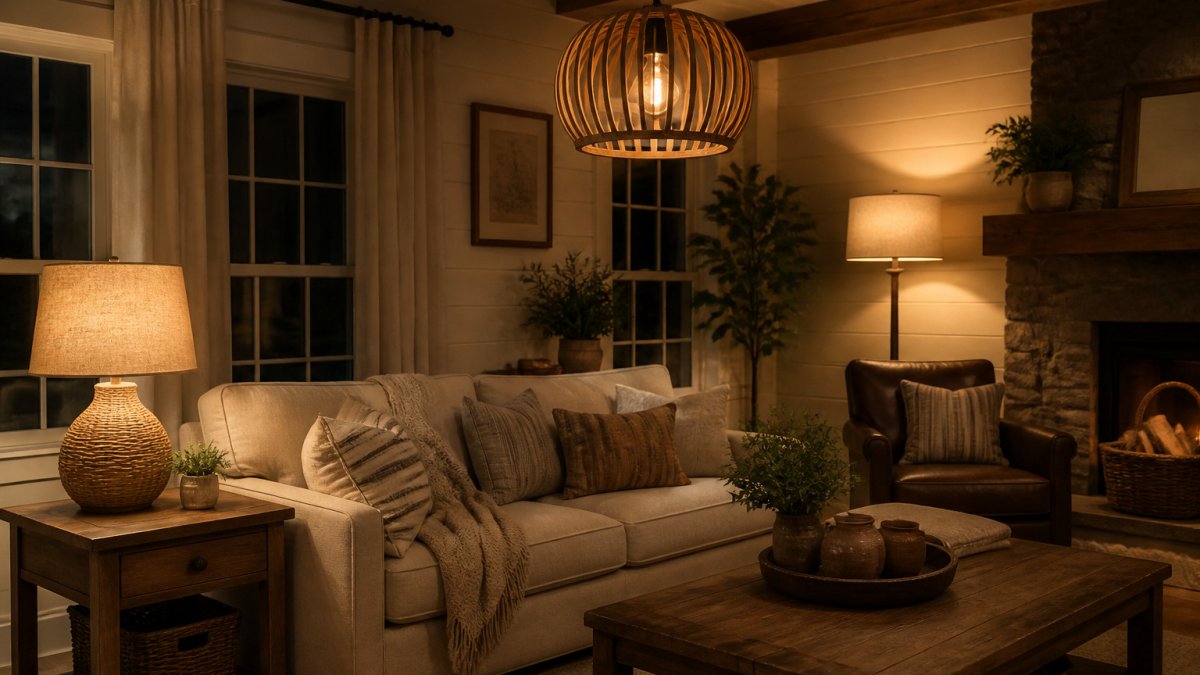
Start with the ceiling fixture for ambient light, then add one or two lamps at seating height. Accent light, such as a candle lantern on a shelf or console, finishes the room. Aim for a mix of heights so light falls on different surfaces rather than from one point.
Common mistake: relying on the ceiling alone. A single source at the top of the room flattens everything below it. Adding two low lamps usually changes the feel more than any new fixture overhead.
Choosing Farmhouse Chandeliers for Living Room Ceilings
A farmhouse chandelier anchors the room, but it should suit the ceiling, the seating group, and the sightlines from the doorway. Look for a warm metal finish and simple, open shapes that feel rustic without looking heavy. The practical part most guides skip is sizing and placement, so use the rules below as a starting point and adjust for how you actually use the room.
Sizing and Hanging Height
A common rule of thumb for a living room chandelier is to add the room's length and width in feet, then treat that number as the maximum fixture diameter in inches. A 12 x 16 ft room, for example, points to a fixture no wider than about 28 inches. The fixture should also read as narrower than the seating group below it so it doesn't overpower the furniture.
Hanging height depends on what is underneath:
- Over a coffee table or open seating area: keep the lowest point about 7 feet above the floor so people can walk under it comfortably. If the room has a vaulted ceiling, hang the fixture so it sits roughly 7 to 8 feet above the floor rather than trying to fill the full height.
- Over a dining table in an open-plan living space: hang the lowest point 30 to 36 inches above the tabletop.
- In a walkway or transition zone: keep at least 7 feet of clearance.
- Low ceilings (8 feet or less): choose a flush-mount or semi-flush fixture, or a chandelier no taller than about 12 inches, and skip long chains.
For a two-story or vaulted room, a larger fixture (30 to 36 inches) can hold the space, but add a dimmer so it doesn't dominate at night. In small rooms under about 120 square feet, a 20- to 24-inch fixture or a pair of pendants usually feels better than one large chandelier.
Pendants, Lanterns and Floor Lamps Compared
Pendants give focused light and suit a corner, reading nook, or pair over a console. Lanterns add a softer, decorative glow and work well as accents on a shelf or side table. Floor lamps fill a dark corner and provide task light beside a chair, while table lamps at seating height are the easiest way to add warmth without wiring changes.
The 18" & 11.5" High Hanging Candle Lanterns with LED Pillar Candles are an option if you want a hanging or standing lantern that glows without open flame. For a warm wood-and-glass look, the Decorative Bamboo Woven Lantern Holder brings natural texture to a shelf or corner.
Matching the Fixture to Your Ceiling and Layout
Ceiling height and room layout change the recommendation more than style does:
- Standard 8-foot ceiling: flush-mount or semi-flush fixtures, plus lamps and sconces for layers.
- 9- to 10-foot ceiling: a small chandelier or pendant with a short chain works well over a seating group.
- Vaulted or two-story ceiling: a larger chandelier hung lower than the peak, with a dimmer, keeps the room cozy instead of cavernous.
- Open-plan living and kitchen: use matching or coordinated pendants over the island and a chandelier over the living zone so the two areas read as one scheme.
- Small or narrow room: a pair of small pendants or a single medium fixture plus two lamps usually feels more balanced than one large chandelier.
Measure the room, note the ceiling height, and choose the fixture last. That order keeps the chandelier proportional to the space rather than to the photo you saved.
The article gives these sizing and hanging-height rules for chandeliers, which you can check against your own room.
| Situation | Hanging height or size | Note |
|---|---|---|
| Over coffee table or open seating | Lowest point about 7 ft above floor | Keeps walkway clear |
| Over dining table (open plan) | 30 to 36 in above tabletop | Lowest point measured from table |
| Walkway or transition zone | At least 7 ft clearance | Avoids head-height contact |
| Low ceiling (8 ft or less) | Flush-mount or 12 in max chandelier | Skip long chains |
| Small room under 120 sq ft | 20 to 24 in fixture or pair of pendants | Better than one large chandelier |
| Room diameter rule | Room length + width in ft = max diameter in in | Example: 12 x 16 ft gives about 28 in |
Warm Lighting for a Living Room: Bulbs, Brightness and Dimming
Bulb colour temperature changes the mood more than the fixture does. For a cozy farmhouse feel, choose warm-white bulbs, usually around 2700K, which give a soft amber glow. Cooler bulbs above 4000K look clinical in a living space.
Natural Rattan and Fabric Table Light | Modern Coastal Desk Lamp →
Brightness matters too, and it is where most guides stay vague. As a starting point, a living room needs roughly 10 to 20 lumens per square foot of ambient light, with task lighting added on top. A 200-square-foot room therefore lands around 2,000 to 4,000 lumens total, spread across several fixtures rather than one.
Use dimmable bulbs on every fixture you can, so the room works in the evening as well as during the day. Put the ceiling light on a dimmer if you can, and keep lamps brighter for reading.
Most lamp and lantern fixtures accept standard E26 or E27 bulbs. Check each product's listing before buying, as some lanterns are designed only for battery or LED candles.
If you are replacing bulbs gradually, start with the fixtures you use most in the evening, usually the ceiling light and the reading lamp. Those two changes make the biggest difference to how cozy the room feels.
Budget-Friendly Farmhouse Light Fixtures That Still Look Right
You do not need a large budget to get the look. Spend on the fixture people see first, usually the ceiling piece or the main lamp, and keep accents modest. A pair of matching lanterns often does more for a shelf than one expensive piece.
The 11'' High Metal Decorative Candle Lantern Hanging Candle Holder (Set of 2) at 36.99 is a way to add two matching accents. Its listing describes use with LED candles (not included), which give a glow without an open flame.
Watch out: mixing too many small fixtures in one room can look scattered. Two or three matching pieces usually look more intentional than six different ones.
Finishes, Materials and Mixing Farmhouse Styles
Farmhouse lighting works best when finishes repeat across the room. Pick one or two metal tones and one natural material, such as wood or rattan, then echo them in your fixtures, frames and accessories.
Mixing traditional and modern elements is fine if the palette stays calm. A rattan table lamp can sit beside a metal lantern, as long as both share a warm, neutral tone. The Natural Rattan and Fabric Table Light | Modern Coastal Desk Lamp, priced at 105.00, is made from natural rattan and linen-blend fabric.
The White Rattan Pagoda Lanterns (Set of 2) at 87.00 are handwoven rattan pieces with tiered roofs that can be displayed on a table or sideboard.
Setting Up Your Cozy Living Room Lighting This Weekend
You can set up a layered plan in an afternoon. Start by listing the room's three zones: ceiling light, seating area and accent spots. Check which outlets and switches you have, then decide where each fixture goes.
Next, buy or choose bulbs in one warm-white temperature, and put lamps on separate switches if possible. Hang or place the main fixture first, then add lamps and accents, and adjust brightness once the room is dark.
Sit in the room in the evening and check where the light falls. Move a lamp if a corner feels dim, and dim the ceiling light if it feels harsh. Small adjustments at this stage make the biggest difference to how cozy the room feels.
Frequently Asked Questions
What type of lighting is best for a farmhouse living room?
Layered lighting works best: one central fixture such as a chandelier or flush mount for general light, one or two table or floor lamps for task and ambient light, and a few accent sources like lanterns on a sideboard. Using a single overhead light makes the room feel flat. Mixing these sources lets you dim or switch them separately, which is what makes the room feel cozy in the evening rather than bright and bare.
What size chandelier should I choose for a farmhouse living room?
As a starting point, add the room's length and width in feet and use that total as the fixture diameter in inches. A 14 by 16 foot room suggests a fixture about 30 inches across. Hang the bottom of the fixture about 30 to 36 inches above a coffee table, or about 7 feet from the floor in rooms with standard ceilings. Measure the table first, because a fixture hung too high looks lost and one hung too low blocks sightlines.
Are warm or cool light bulbs better for a cozy living room?
Warm white bulbs, usually around 2700K, are the standard choice for a cozy living room because they give an amber glow similar to candlelight. Cool bulbs above roughly 4000K feel clinical and suit kitchens or workspaces better. Choose a dimmable bulb and a compatible dimmer so you can lower brightness in the evening. Check that the bulb base matches your fixture, as E26 and E27 are the common US and international sizes for lamps.
Is farmhouse lighting still in style?
Yes, but the most lasting versions are simple and mix well with other styles. Black metal, brushed nickel and natural wood or rattan remain popular, and pairing a rustic piece with a clean modern lamp keeps a room from looking like a theme. Avoid overly distressed or novelty fixtures if you want a look that will not date quickly, and choose quality materials you can keep for years.
