

Table of Contents
- Solid Wood vs Particle Board Furniture: The Core Difference
- Particle Board Furniture Pros and Cons
- Durability, Strength and Load-Bearing Capacity
- How to Tell Solid Wood from Particle Board
- Particle Board vs Plywood Furniture: Where Each Fits
- Cost, Lifecycle Value and Environmental Impact
- Particle Board Furniture Care and Solid Wood Maintenance
- Frequently Asked Questions
Last Updated: October 19, 2026
Solid Wood vs Particle Board Furniture: The Core Difference
Solid wood is lumber cut from a single tree, while particle board is an engineered composite made by pressing wood chips, sawdust and resin into a dense panel. That single distinction drives almost every trade-off in this guide from Charmed Cottage Living, from how long a piece lasts to how it handles a spilled drink.

The difference shows up fast. Solid wood furniture can be sanded, refinished and repaired for decades. Particle board furniture is cheaper to buy, but a stripped screw hole or a swollen edge often means the end of the piece.
Below, we break down the comparison the way we would walk a friend through it in our own showroom: honestly, with the weak points on both sides named.
Particle Board Furniture Pros and Cons
Particle board furniture wins on cost and consistency, and loses on repairability and moisture tolerance. That is the honest summary, and the pros and cons below show why both sides matter.
Pros:
- Affordable entry price, which makes it a practical first-furniture option
- Uniform, flat panels that cut and finish cleanly
- Available in a huge range of veneers and laminates
- Lighter than solid wood, so easier to move
- Stable in dry, climate-controlled rooms
Cons:

- Swells and crumbles when moisture reaches the raw edges
- Screw holes strip easily and are hard to repair
- Heavy loads can bow shelves and sag seat bases over time
- Hard to refinish once the surface layer wears through
- Rarely survives repeated disassembly and reassembly
A common mistake is judging particle board by its surface. A convincing veneer hides the core, so the panel looks like solid timber until a hinge pulls loose. Check the edges and the underside before you buy, not the top.
Durability, Strength and Load-Bearing Capacity
Solid wood generally outlasts particle board because its fibers run continuously through the piece, while particle board relies on resin bonds between chips. Those bonds are strong in compression but weak against pulling forces, which is why fasteners are the first thing to fail. The practical consequence is that particle board furniture rarely fails because the panel itself breaks; it fails at the joints, hinges, and screw holes where concentrated loads pull outward.

Density and construction decide how much a panel can take. Particle board is typically denser than solid wood by volume, but density is not the same as fastener-holding strength. A screw driven into the face of a particle board panel grips the compressed chips around it; once those chips crumble, the hole enlarges and the screw spins. Solid wood, by contrast, holds a screw along the length of the grain and can be repaired with a dowel plug and re-drilled. That difference explains why a solid wood dresser with expert joinery will hold heavy drawers and daily use for decades, while a particle board cabinet does best with light contents and a fixed position.
Shelf spans matter too. Long unsupported particle board shelves bow under books because the panel has limited stiffness across its span and no continuous grain to resist creep. Solid wood resists that sag far better, and a hardwood shelf can often be flipped or re-supported. As a rule of thumb used by many furniture makers, keep unsupported particle board shelf spans short and support the midpoint on anything expected to carry a full row of books or files.
Where does each material hold up best?
| Use Case | Particle Board | Solid Wood |
|---|---|---|
| Bedroom dresser, daily use | Fair, watch the drawer runners | Excellent, repairable |
| Dining chairs, frequent seating | Poor, joints loosen | Excellent, holds fasteners |
| Bookshelves with heavy loads | Fair, risk of bowing | Good to excellent |
| Bathroom or laundry cabinetry | Poor, moisture risk | Good if sealed |
| Occasional accent pieces | Good value | Excellent longevity |
| Beds and bunk frames | Poor to fair, racking stress on fasteners | Excellent, tolerates movement |
Beds deserve a special note because they combine sustained load with movement. A particle board bed frame concentrates stress at the rail brackets every time someone sits down, and those brackets are exactly where the material is weakest. A solid wood frame distributes that stress through the rails and posts.
How to Tell Solid Wood from Particle Board
You can identify solid wood by looking at end grain, edges and weight, and by checking whether the grain pattern repeats. Real timber shows continuous grain on faces and edges, with visible growth rings at the end grain.
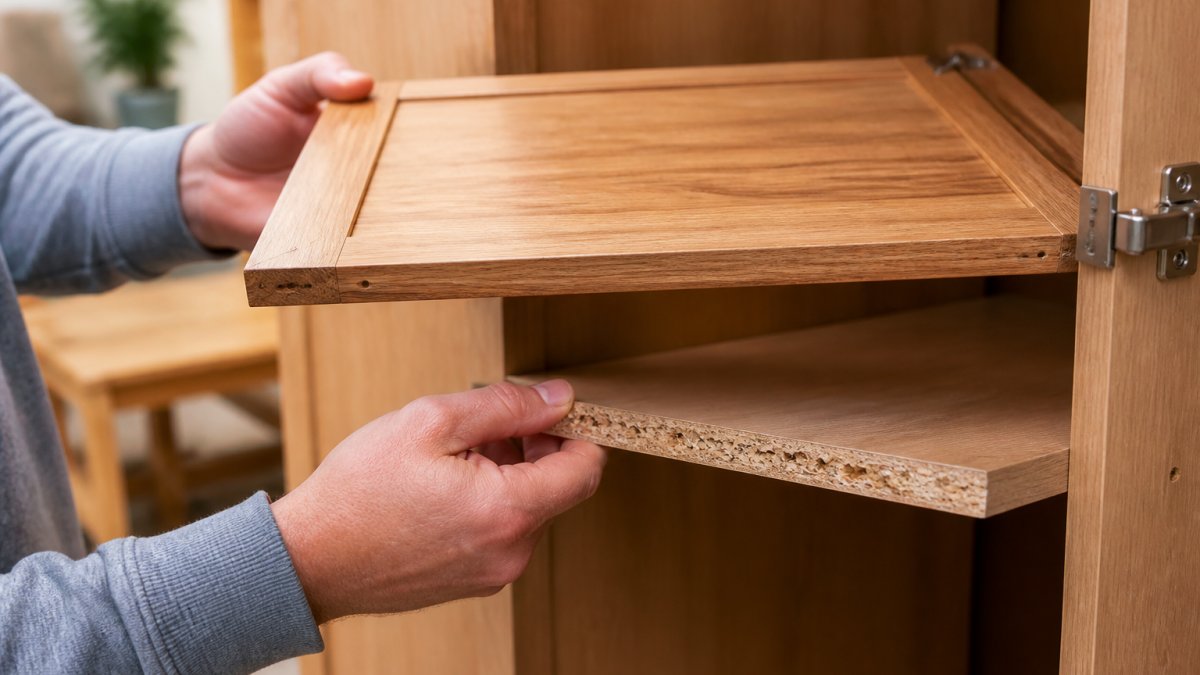
Run through this checklist before you commit:
- Look at an unfinished edge: chips or flakes mean particle board, continuous grain means solid wood
- Check whether the grain pattern repeats across the surface, a sign of veneer over composite
- Lift a corner: particle board feels dense but dead, solid wood carries weight differently
- Inspect screw holes and hinges for crumbling or stripped threads
- Tap the panel: a hollow, dull sound suggests a composite core
- Ask what the core is made of, not just what the finish is called
Veneer and laminate are not automatically bad. A veneered panel can be well built. The point is knowing what sits underneath, because that core decides how the piece ages.
Particle Board vs Plywood Furniture: Where Each Fits
Plywood is stronger and more moisture tolerant than particle board because it is built from crossed layers of wood veneer, while particle board is pressed from chips. That layered construction spreads stress and resists swelling far better.
Roundhill Furniture - Rocco Contemporary Solid Wood Dining Chairs (Set of 2) →
So where does each belong? Particle board suits budget flat-pack pieces, wardrobe carcasses and low-traffic storage in dry rooms. Plywood fits furniture that sees moisture, movement or heavier loads, such as kitchen units, bathroom vanities and workshop benches. Solid wood remains the choice for heirloom pieces and anything with visible grain as a design feature.
If you are weighing particle board vs plywood furniture for a specific room, ask one question: will this piece ever get damp or moved? If yes, plywood or solid wood earns its higher price.
Cost, Lifecycle Value and Environmental Impact
Particle board costs less up front, but solid wood usually wins on lifecycle value because it can be repaired and refinished instead of replaced. A cheaper piece bought three times often costs more than one well-made piece bought once. This is the gap most buying guides skip: instead of comparing sticker prices, compare cost per year of use.
The calculation is simple. Divide the purchase price by the number of years you expect to keep the piece, then add any repair or replacement costs you anticipate. A solid wood piece that lasts for decades and can be refreshed with a light sanding spreads its cost thinly across its life. A budget panel that fails in a few years has to be bought again, and again. The same logic applies to repairs: a stripped hinge screw in solid wood can often be fixed with a dowel and glue for very little, while the same failure in particle board usually means the piece is finished. When you compare a particle board desk that may need replacing after a move against a solid wood desk that can be disassembled and reassembled, the lifecycle math often favors the higher upfront price.
Environmental impact cuts both ways. Particle board makes use of wood chips and offcuts that would otherwise be waste, which is a genuine efficiency gain, and it uses less solid timber per panel. Solid wood from renewable, well-managed sources, like the acacia hardwood used in our Legacy Solid Wood Dresser, offers durability that reduces replacement demand over time. The honest framing is that neither material is automatically greener; sourcing, adhesives, and end-of-life disposal all matter. Look for makers who describe where their wood comes from and how panels are finished.
Indoor air quality deserves a mention too. Composite panels can emit formaldehyde from the resins used to bind them, which is why reputable makers publish emission information and why ventilating a newly furnished room matters. The key point is that emissions depend on the product standard and certification, not simply on whether a panel is particle board. Ask for that documentation, and prefer panels with low-emission certification where it is offered. A well-certified particle board panel can have lower emissions than a poorly finished solid wood piece.
For a cottage or traditional interior, our solid rubberwood bar stools show the practical difference: a solid frame rated to hold up to 330 lbs per stool, with a grain finish that reads warm rather than printed.
Particle Board Furniture Care and Solid Wood Maintenance
Particle board furniture care comes down to moisture control and gentle handling, while solid wood maintenance is mostly about occasional cleaning and re-oiling. Both materials reward a little attention.
For particle board:
- Wipe spills immediately and never let water sit on seams or raw edges
- Use coasters and seal exposed edges where you can
- Avoid placing pieces in bathrooms, basements or against damp walls
- Tighten fasteners gently; over-tightening crushes the core
- Move pieces by lifting, never dragging
For solid wood:
- Dust with a soft cloth and clean with a barely damp rag
- Re-oil or wax every year or so to keep the finish fed
- Keep pieces out of direct sun to slow color shifts
- Use felt pads under items that slide
- Address small scratches early, before they deepen
The contrast is the whole story of this comparison. Particle board asks you to prevent damage. Solid wood lets you repair it.
Frequently Asked Questions
Is solid wood furniture more durable than particle board furniture?
Solid wood generally outlasts particle board furniture by a wide margin. Hardwood pieces like acacia and rubberwood resist warping and cracking and can be sanded and refinished when they show wear. Particle board is made from compressed wood chips and resin, so it holds up well under normal use but loses strength once moisture gets into an exposed edge. For a dining table or dresser you plan to keep for years, solid wood is the safer long-term choice.
How can you tell whether furniture is solid wood or particle board?
Look at the edges and undersides. Solid wood shows continuous grain that wraps around corners and looks the same on the end grain as on the face. Particle board has a flat, uniform surface, often with a thin veneer or laminate, and exposed edges reveal wood chips or a paper-thin layer. Check screw holes too: solid wood holds threads cleanly, while particle board crumbles or strips if a fastener is removed and reinserted.
Is particle board furniture worth buying?
It depends on the piece. Particle board furniture pros and cons come down to price against lifespan: it costs less, comes in consistent finishes and works well for bedroom storage or accent pieces that stay dry and rarely move. Skip it for anything that takes heavy loads, sits in humid rooms or will be disassembled more than once. If the piece is a long-term investment for your living room, spend more on solid wood.
How should you care for particle board and solid wood furniture?
For particle board furniture care, wipe spills immediately, keep pieces away from humid rooms and seal any chipped edge with a matching paint or edge band. Solid wood needs less caution but still benefits from a yearly oil or wax coat, a coaster under every drink and a stable indoor humidity level. Rubberwood and acacia frames, like the ones on solid wood dining chairs and bar stools, stay sturdy for years with simple dusting and occasional conditioning.
Choosing furniture is really a decision about how long you want a piece to stay in your home. If you want warmth, character and craftsmanship that ages gracefully, Charmed Cottage Living curates solid wood pieces designed to become part of your story, from acacia hardwood dressers with expert joinery to dining chairs built on solid rubberwood legs. Explore the collection and furnish your sanctuary with pieces made to last.